

Cover photograph: Shanghai from the Bund, 2019. Shane54MM / Alexander Weih, Wikimedia Commons · CC BY-SA 4.0
A box can look perfect in a photograph and become awkward the moment you open it: the product moves around, there is no room to lift it out, or a finely drawn logo loses definition on the chosen paper. These details rarely steal the show, but they decide whether packaging works. They are our starting point for looking at the forthcoming interpack China.
Shanghai, 16–18 November
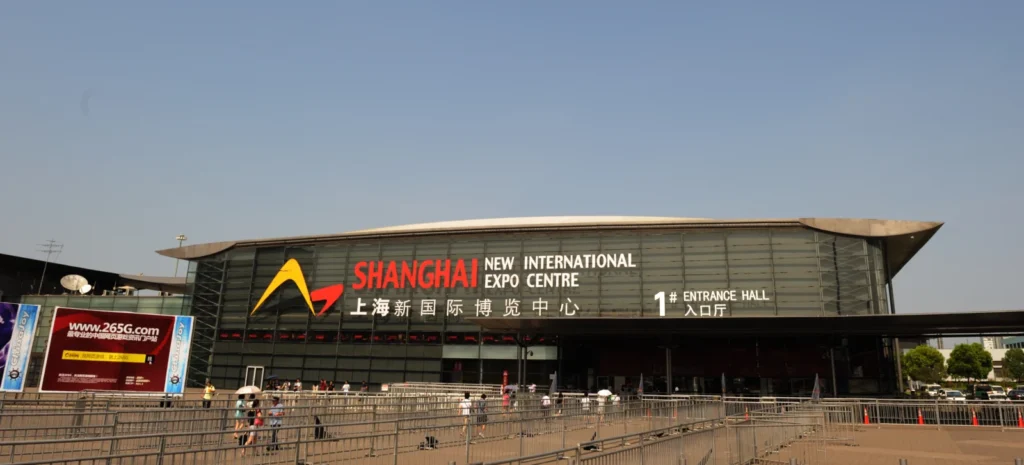
interpack China 2026 takes place from 16 to 18 November at the Shanghai New International Expo Centre (SNIEC), according to the official event page. Those who know it as swop, Shanghai World of Packaging, will find the exhibition under its new name, adopted from 2026 and announced by the organisers.
The announced programme covers machinery, processes, materials, printing, labelling and digital solutions. Not every development will be relevant to someone ordering a presentation box or folding carton. We have picked out a few things to consider with an actual packaging project in mind, whether or not you travel to Shanghai.
Look at the paper up close
Colour is usually the first thing you notice in a paper swatch book. Next, turn the sheet over, feel its surface and see how it behaves around a fold. A pronounced texture can give a box character. If your artwork has small lettering or fine lines, however, the print needs to be tested on that surface.
In a rigid box, structural board and covering paper do different jobs. A folding carton takes its shape through cutting, creasing and gluing the paperboard itself. Choose the material alongside the structure. Our paper guide explains what to compare before settling on a finish.
If a material is described as sustainable, ask which properties support that description and how they apply to the complete package, including adhesives, finishes and the insert. The word alone tells you very little about a particular design.
A good insert lets the product out, too
A precise cavity should hold the contents securely and still make them easy to remove. Start with the actual product dimensions: a cap, projecting edge or fragile part can change the shape required. Think about how much of the product should remain visible and where someone can place their fingers.
A shaped cardboard insert and a foam insert offer different possibilities. Appearance is only part of the decision. Product shape, weight, arrangement and intended use matter as well. For a set containing several items, design the box and insert together.
3D is useful. A sample answers other questions.
A preview helps compare proportions, opening methods and product layouts before a prototype is built. Behind the image are components that need to be cut and assembled. Board thicknesses, paper turn-ins, clearances and sheet layouts still have to be defined.
At Scatole.com we use Cartis, our design and production management software, to connect models, dimensions, materials and job progress. Material optimisation includes the yield from each sheet: changing a format can change how many pieces fit. The benefit needs to be assessed for the actual design and quantity.
A physical sample remains necessary when checking the feel of the paper, print reproduction, product removal or closure. A clear 3D view helps you make decisions. It cannot tell you how a drawer slides or how a lid feels as it opens.
Watch the process through to the finished piece
During a demonstration, it is easy to focus on machine speed. We would also look at format changes, covering paper alignment and inspection of the finished piece. For a custom box, quality needs to be checked using the chosen material and the required production method.
Our workshop video shows a covering operation carried out by hand. Positioning the material, guiding the fold and finishing the edges still matter when advanced software is used for design. Technology helps prepare the work; the piece then has to be made and checked.
Where to start with your box
Before choosing a model, gather the product dimensions, weight, intended quantity and presentation requirements. State whether the dimensions you provide are internal or external. If you already have artwork, send it with the brief: structure and printing affect one another.
Compare a base and lid box, a magnetic presentation box or a drawer box by considering how you want it to open. For a collection of vials, the Discovery Set helps you work through their arrangement. For a printed paperboard carton, start with the Folding Carton Studio.
Choosing the model begins the project. Before production, agree what the sample needs to establish: product fit, removal, closure and finish. That is where an idea seen at a trade fair can become a practical choice for your product.