
A bottle with two glasses, a box with three shaped cavities, a case holding components of different shapes. The inserts in this guide use different materials and constructions, but each has a clear job: give every product its own place and leave room to pick it up.
At Scatole.com we can design inserts in standard polyurethane foam at 18 kg/m³, high-density polyurethane foam at 65 kg/m³ and microflute corrugated cardboard. We start with the contents: dimensions, weight, delicate areas, arrangement and intended use. The material name is one part of the decision.
18 and 65 kg/m³: what actually changes?
These numbers describe mass per unit volume. An uncut block measuring 10 × 10 × 10 cm occupies one litre. At the stated densities, its nominal mass is approximately 18 grams or 65 grams. Compare weight using the same volume of material.
Density and compression firmness are separate characteristics, as explained by the Polyurethane Foam Association. To understand how an insert behaves, also consider the actual foam grade, thickness and cavity design.
When ordering, specify both the chosen density and what you need the insert to do. “It needs to hold a bottle securely and allow easy removal” describes a design requirement; “65 kg/m³” identifies one of the grades to compare.
Standard polyurethane foam at 18 kg/m³
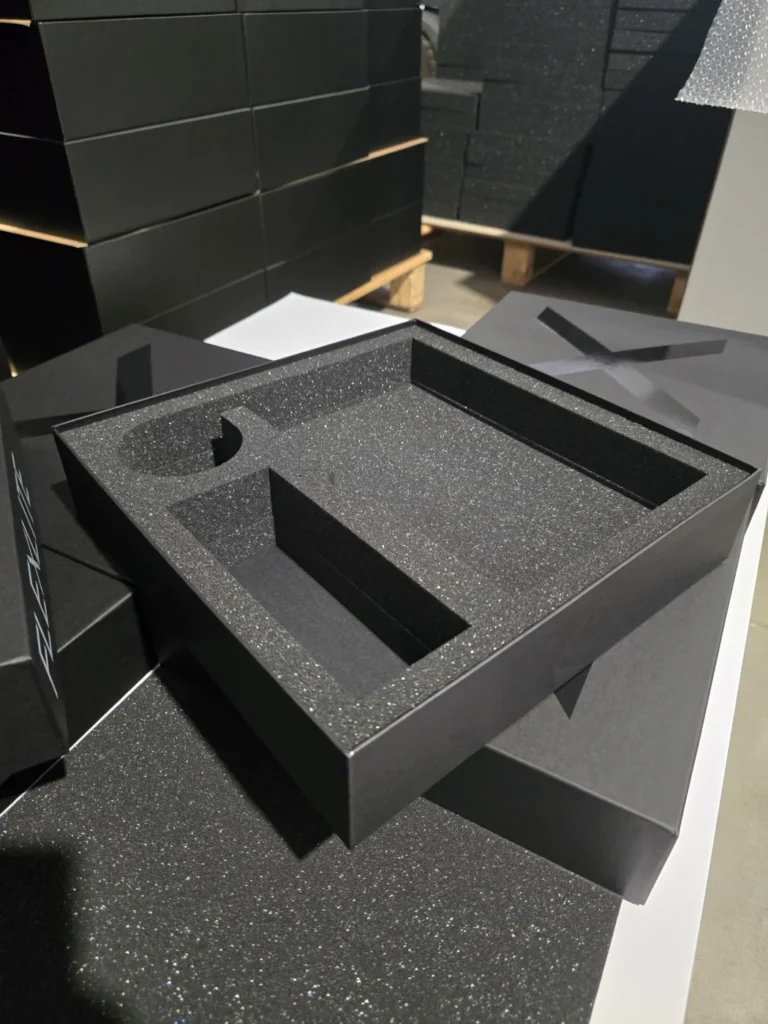
The first photograph shows a black insert with three cavities: one wider opening and two elongated compartments. The cuts follow the planned arrangement of the contents, while the foam thickness provides the depth needed to support them.
The 18 kg/m³ grade is the lower-density option of the two foams compared here. For the same volume, it adds less weight to the insert. If keeping the package lightweight is a priority, it is worth starting with this option and checking support, depth and access on a sample.
Design the cavity around the actual product, including caps, edges and projecting parts. A cavity that is too tight can make removal awkward; too much clearance can allow movement. The foam left between adjacent cuts is also part of the design.
High-density polyurethane foam at 65 kg/m³
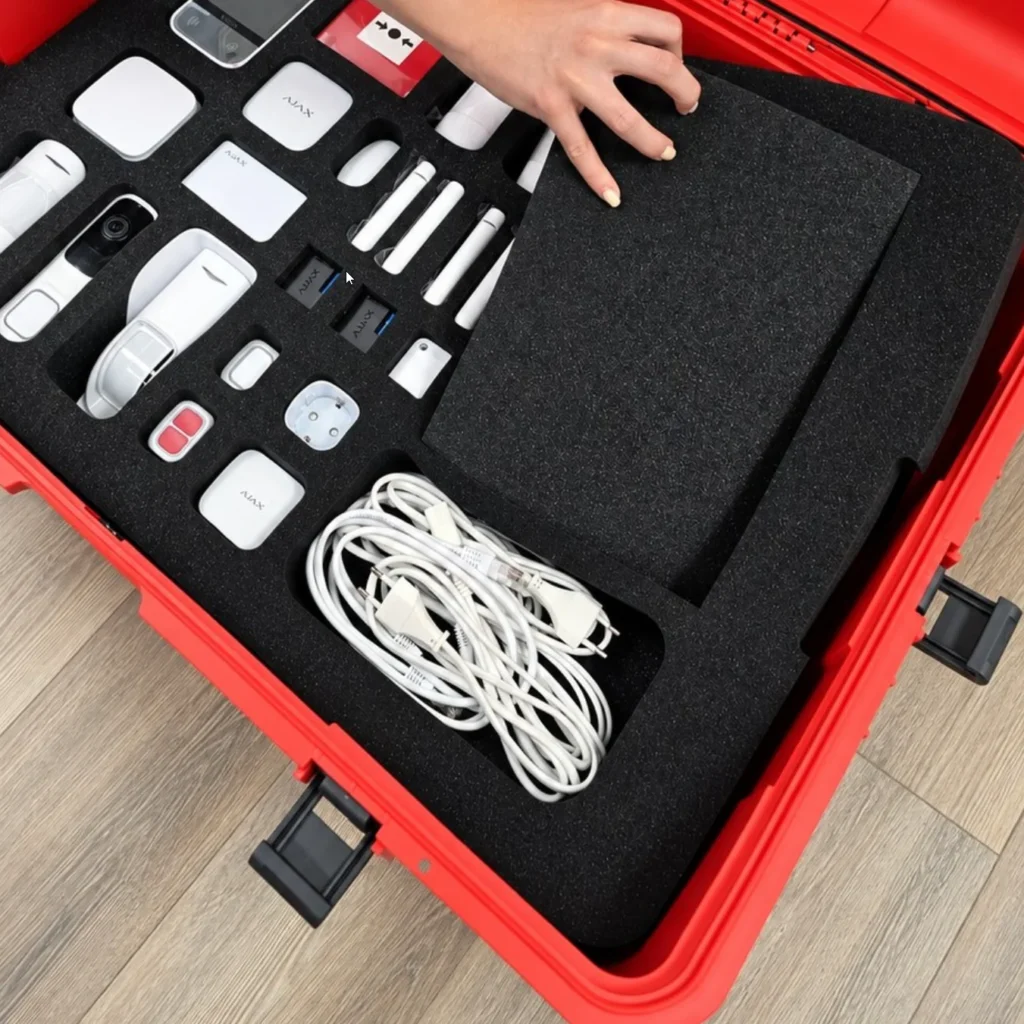
The case in the photograph shows a different arrangement: numerous shaped cavities for different components and a larger compartment for cables. It illustrates how an insert can make the contents of a kit easier to identify and organise as well as keep its parts separated.
The 65 kg/m³ grade contains more mass in the same volume than the standard grade. For a kit that is frequently opened, emptied and repacked, compare the two foams on a sample: product insertion, repeated removal, recovery after compression and the behaviour of cavity edges.
The actual material provides the answer. To choose the density alongside the other characteristics, we also ask how the package will be used: presentation, storage, handling or transport. These uses can call for different checks.
Microflute: the structure creates the fit
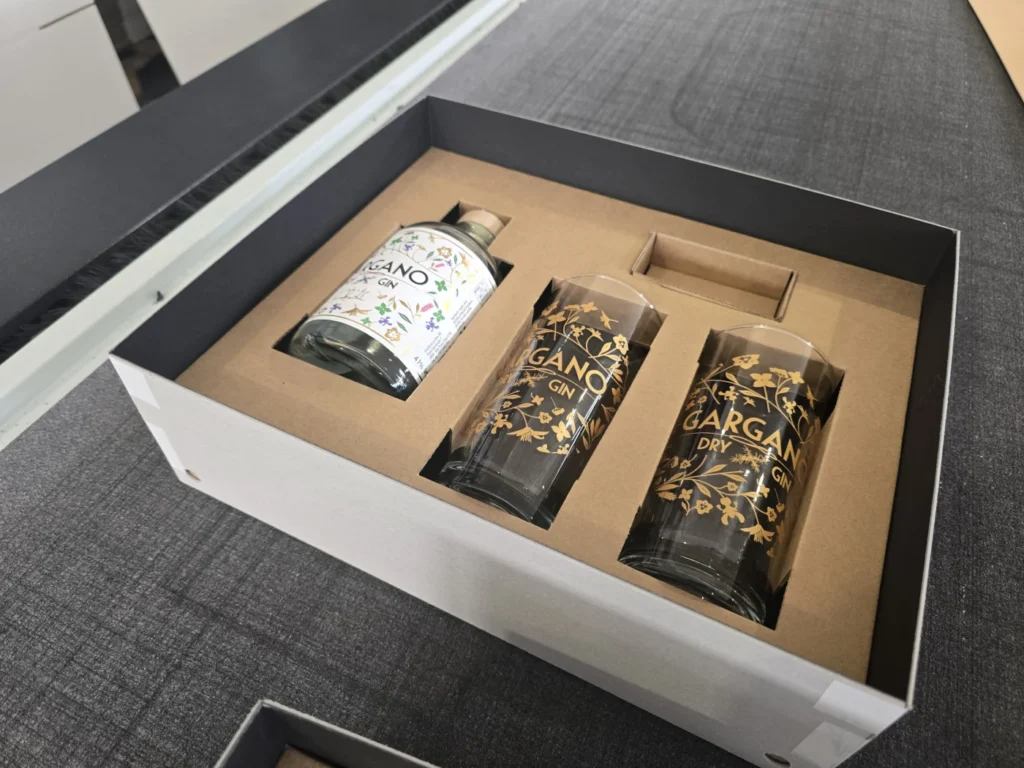
In the box holding a bottle and glasses, the microflute insert forms a presentation platform with openings for individual items and an additional cavity. Its kraft colour makes the different approach to foam clear.
Microflute corrugated cardboard has a fluted layer between its liners. Cuts, folds, walls and supports can be combined to position the product. Flute profile and board composition influence the material’s characteristics, as described by FEFCO.
Distinguish board thickness from the height of the assembled insert: they are different dimensions. A raised platform can create the space needed by the contents through its construction. Consider where the insert contacts the product, especially around delicate surfaces or projecting parts.
Three insert options compared
When comparing alternatives, keep the product, box dimensions and arrangement the same. These photographs show different projects; the choice for your packaging depends on your own requirements.
| Insert | How it is designed | What to check on a sample |
|---|---|---|
| Polyurethane, 18 kg/m³ | A shaped block, with height and cavities defined around the contents. | Support, cavity depth, finger access and response to compression. |
| Polyurethane, 65 kg/m³ | A shaped block of higher nominal density, with geometry coordinated with the box. | Insertion, repeated removal, recovery after compression and cavity edges. |
| Microflute corrugated cardboard | Cuts, folds, platforms and supports designed to position the product. | Assembly, stability, contact points, access and box closure. |
Compare quotations for the same configuration and quantity. Material volume, height, the number and complexity of cuts, additional components and assembly all contribute to the project. Density alone does not describe its final cost.
The right height, with room for your fingers
A product can be held securely and still be difficult to pick up. Design the insert from the perspective of the person opening the box, too. Side access, a shallower cavity or a dedicated finger notch can make removal easier.
We can cut the foam to the height required by the project and develop combinations with paperboard or other elements, such as personalised plaques. See an example in our guide to custom boxes with foam and laser-engraved details. Define these options alongside the dimensions and intended use of the contents.
For protection during transport, assess thickness, product weight and fragility alongside the complete packaging system. The PFA technical guide to packaging foam describes these factors. A prototype with the actual product lets you check the design; transport requirements call for appropriate testing.
Where to start with your insert
Send the internal box dimensions, the size and weight of each item, your preferred arrangement and the planned quantity. Explain which parts should remain visible and how you expect the customer to pick up the product. If you have a product sample, we can use it as a reference for the design.
Start with the foam insert configurator or the shaped cardboard insert configurator. For the outer box, compare a base and lid model, a magnetic closure or a drawer box. For specific shapes and heights, add a design request to your configuration.